Channel 07 · History of the Internet · labs.llc/history/
History of the Internet: every date is the day it worked
Sixty years as a dated record with a strict rule about what a date means — counted, captured, and set beside the Internet Society’s essay and the Computer History Museum’s timeline.
Tested 2026-09-27Build 537, local copyDesktop capture 20:14:30ZPhone capture 20:14:36ZPublisher LABS, which also makes this tool
CH 07labs.llc/history/captured 20:14:30Z
1234
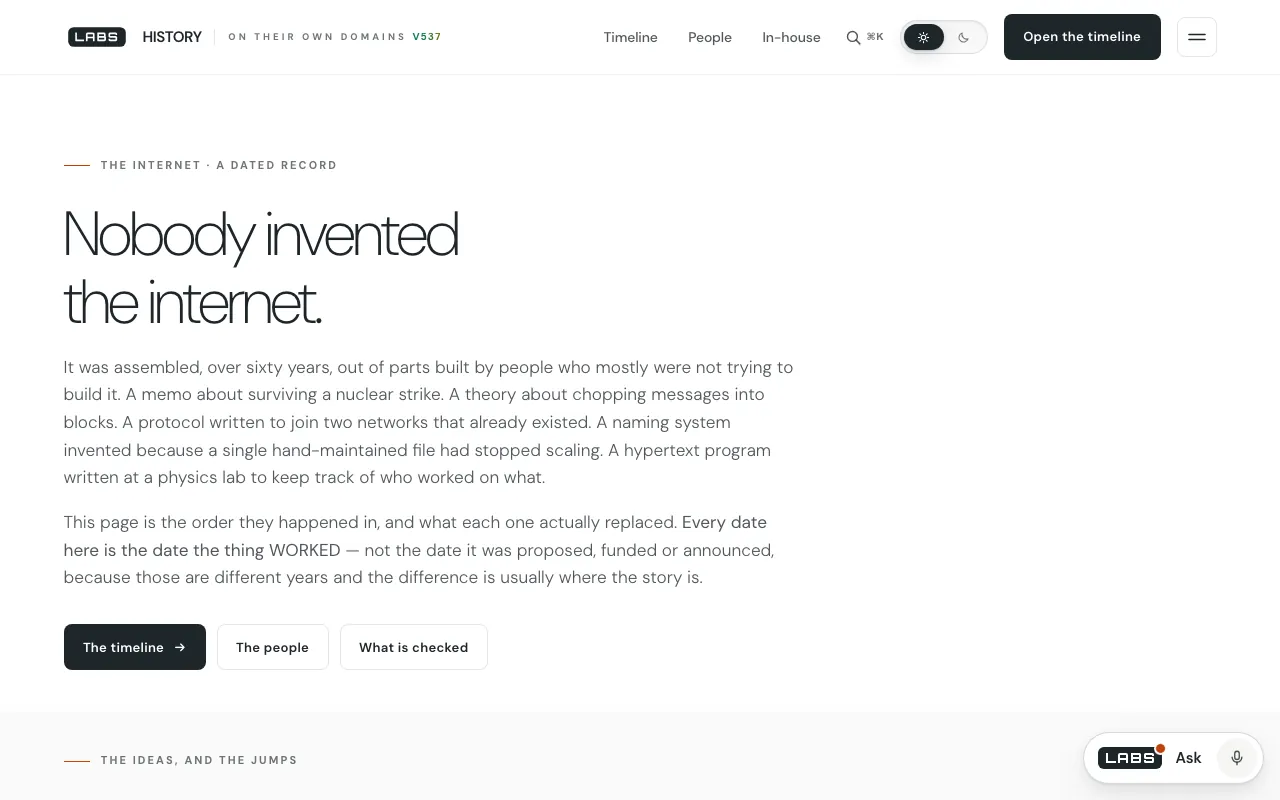
Callouts · desktop capture, 1280 × 800
1Callout 1: The eyebrow: “The internet · a dated record”.
2Callout 2: The rule, set out in the first screen: every date here is the date the thing WORKED.
3Callout 3: “What is checked” — the method section, one click from the top.
4Callout 4: “People”: fourteen of them, drawn from the same record as the timeline.
Segment 1 · On screen
What it is, and who it is for
History of the Internet sets down sixty years as a dated record: 28 entries from Shannon’s bit in 1948 to IPv4 running out in 2011, filterable by six eras, with five drawn plates of the core ideas, fourteen people, and three disputed claims printed as disputed.
It is for students, teachers and curious readers who want the order of events and how each piece worked without a textbook — and for anyone settling an argument about who did what first.
Segment 2 · Behind the picture
How it works
No outside data is fetched while you read. The whole record is one file, history-data.js — 28 events, 14 people, 6 eras — and history.js draws the timeline, the era filter, the people and the plates from it (lines 1–7). Because there is one record, a date corrected once is corrected everywhere, and the era counts cannot drift away from the entries.
The page’s discipline is in what counts as a date. Every entry is dated to when the thing worked, not when it was proposed, funded or announced (history-data.js lines 4–7): ARPANET to its first message, TCP/IP to the flag day, the web to the first page served from another machine. Where historians genuinely disagree, the entry carries the dispute instead of naming a winner — packet switching reached independently by Baran and Davies, the first ARPANET message, the first email between two machines (history.js line 270). And it refuses photographs: the five plates are drawings of mechanisms, such as packets crossing a mesh or intelligence at the ends of a simple network (lines 8–14).
What it reads
None fetched at run time: the record is written into history/assets/js/history-data.js
No bibliography or source links in the record (none found when we searched it)
Segment 3 · The test
What we measured, and when
At 20:16:11 UTC the page came back from the local copy at 41,311 bytes in 0.0013 seconds, and its record file at 14,217 bytes. We ran the record through JavaScriptCore, the engine built into macOS, and counted: 28 events, 14 people, 6 eras (ideas, ARPANET, protocols, names, web, after), 3 disputed entries, 9 dated to an exact day, the last in 2011 — “IPv4 runs out”.
Then we searched the HTML itself for “Shannon” and “Kleinrock” and found neither. The timeline, the people and the plates are written into the page by script; the HTML holds the headings and empty containers. Our capture (20:14:30 UTC) shows the first screen, which is plain HTML and reads well; everything below it depends on JavaScript.
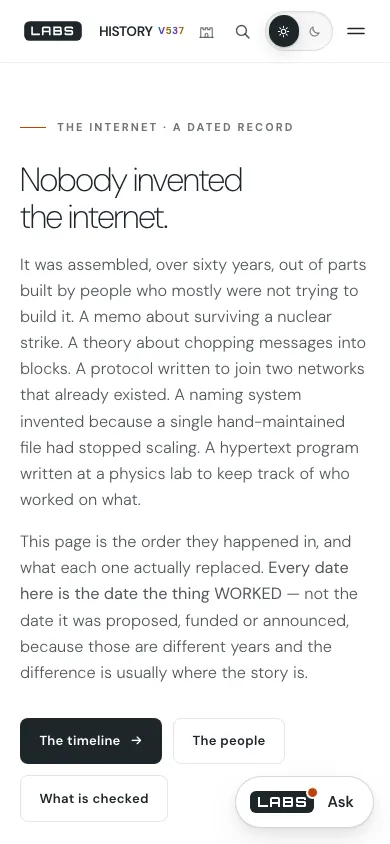
390 × 84420:14:36Z
12
Callouts · phone capture, 390 × 844
1Callout 1: The dating rule stays in the first screen at 390 pixels.
2Callout 2: The three buttons wrap onto two rows.
Segment 4 · Other channels
Beside Internet Society and Computer History Museum
Each comparator was checked on the date shown. We say what each does better before we say where History of the Internet goes further.
A 1997 essay by people who built the internet — Leiner, Cerf, Clark, Kahn, Kleinrock, Lynch, Postel, Roberts and Wolff — from Licklider’s “Galactic Network” to commercialisation in the mid-1990s.
What it does better
First-hand authority, and ten numbered footnotes with a references section a reader can follow.
Where History of the Internet goes further
The labs page carries the story on to 2011, dates each step to when it worked, flags disputes in place, draws each mechanism, and filters by era.
The museum’s decade-by-decade timeline from 1962 to 1992, with a poster of the period.
What it does better
A museum’s collection and imagery behind it, and more entries per decade between 1962 and 1992.
Where History of the Internet goes further
The labs page begins with the ideas — Shannon in 1948, Kleinrock in 1961 — runs past 1992 to the web, DNS and IPv4 exhaustion, and marks its three contested claims as contested.
Segment 5 · Dropouts
Where it falls short
No sources are cited. The record carries no links or references, so a date cannot be checked against a primary document; the Internet Society’s essay can be.
With JavaScript off, the timeline, the people and the plates are empty.
It stops in 2011: nothing on mobile, the cloud or anything since.
Twenty-eight entries choose the jumps; this is not a year-by-year chronology.
Segment 6 · End card
The verdict
A strict, well-drawn record with a clear rule about dates and an even hand with disputes — let down by citing nothing. Read it for the order and the mechanisms; read the Internet Society’s essay for the footnotes.