Channel 06 · DNS propagation · labs.llc/domains/dns/
DNS propagation: fourteen resolvers, judged against the source
A propagation checker that asks the domain’s own nameservers first and measures every resolver against them — captured, run on wikipedia.org, and set beside two familiar map-based checkers.
Tested 2026-09-27Build 537, local copyDesktop capture 20:14:19ZPhone capture 20:14:24ZPublisher LABS, which also makes this tool
CH 06labs.llc/domains/dns/captured 20:14:19Z
12345
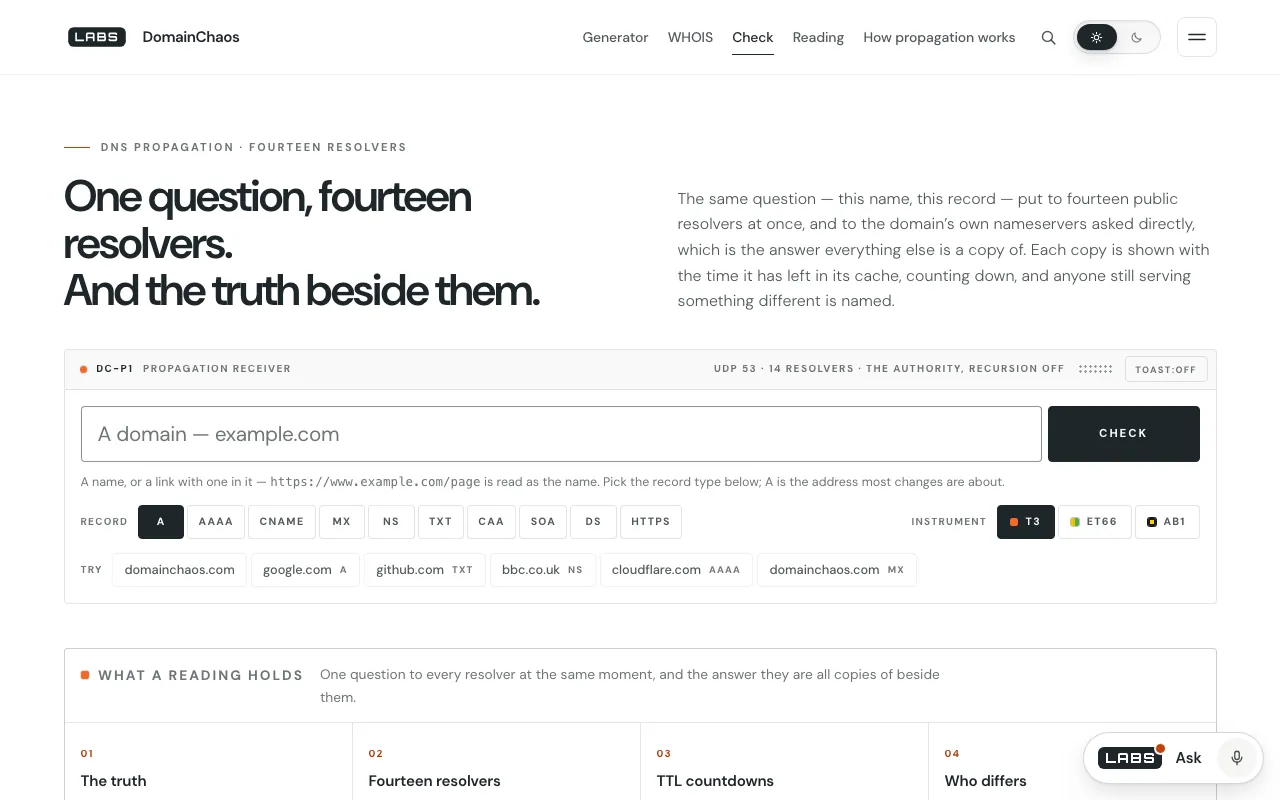
Callouts · desktop capture, 1280 × 800
1Callout 1: The promise in the lede: fourteen public resolvers, and the domain’s own nameservers asked directly.
2Callout 2: The receiver’s header: UDP 53 · 14 resolvers · the authority, recursion off.
3Callout 3: Ten record types, A to HTTPS.
4Callout 4: Three instrument skins — T3, ET66 and AB1 — for the same reading.
5Callout 5: What a reading holds: the truth, fourteen resolvers, TTL countdowns, who differs.
Segment 1 · On screen
What it is, and who it is for
DNS propagation is one of ten instruments on the labs.llc domains desk. You give it a name and a record type; it puts the question to fourteen public resolvers and, beside them, to the domain’s own authoritative nameservers, so every answer is judged against the source. Each cached copy’s remaining lifetime is counted down live.
It is for site owners and administrators who have just changed a record and need to know who still holds the old answer, and for how much longer.
Segment 2 · Behind the picture
How it works
This instrument does its asking on the server, through a same-origin relay (domains/whois/tools.php, op=dns). It does not trust a single answer when it looks for the authority: it asks the parent zone’s servers, takes a referral from a parent server with recursion off, resolves every nameserver, checks that each address is public, and asks each one with recursion off (tools_dns.php lines 16–24). Only then are the fourteen resolvers asked the same question over UDP port 53, with EDNS NSID requested so the page can name the anycast node that answered.
The list reaches past the usual Western set: Google, Cloudflare, Quad9, OpenDNS, Level3, AdGuard, Hurricane Electric, CleanBrowsing, UltraDNS, Comodo and DNS.SB, plus Yandex in Moscow and 114DNS and Baidu inside mainland China. The browser script, dc-dns.js, then applies three rules: the authoritative answer is the truth the others are measured against; a resolver that did not answer counts as no answer, never as agreement; and a different answer is not automatically an old one — location-aware DNS, filtering resolvers and the national firewall are named as likelier reasons, marked as probable (lines 18–24).
What it reads
Fourteen public resolvers, asked directly over UDP 53
The domain’s own authoritative nameservers, found through the parent zone and asked with recursion off
All through domains/whois/tools.php on the labs.llc server
Segment 3 · The test
What we measured, and when
At 20:15:42 UTC we asked the local copy for wikipedia.org, type A. The relay answered in 0.33 seconds (322 ms inside the engine), uncached, after 25 DNS questions and no errors. Three Wikimedia nameservers answered with authority — the aa flag set, TTL 180, serial 2026060420 — giving 208.80.154.224. All fourteen resolvers answered; ten matched the authority. Yandex and 114DNS returned 185.15.59.224, DNS.SB 103.102.166.224 and Baidu 31.13.68.169. Remaining lifetimes ran from 2 seconds at Cloudflare to the full 180.
The verdict it drew was not “not propagated”. It read four different answers from fourteen resolvers as geo-DNS suspected, and said a different address here is expected and is not a stale record; its notes named the filtering resolvers and the two mainland-China resolvers separately, each reason marked probable. That caution is earned: three of the odd answers end in .224, as the authority’s does, but Baidu’s 31.13.68.169 does not, so geo-DNS alone may not explain it. The desktop capture is from 20:14:19 UTC.
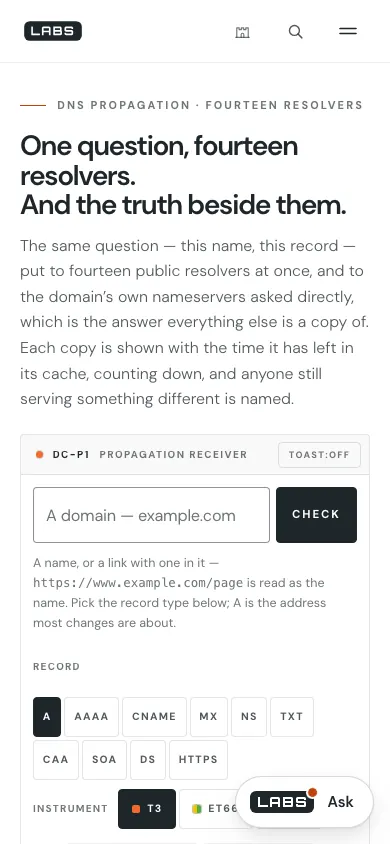
390 × 84420:14:24Z
12
Callouts · phone capture, 390 × 844
1Callout 1: At 390 pixels the ten record types wrap into two rows.
2Callout 2: The Ask launcher covers the instrument picker in this first-screen capture.
Segment 4 · Other channels
Beside DNSChecker.org and whatsmydns.net
Each comparator was checked on the date shown. We say what each does better before we say where DNS propagation goes further.
Checked 2026-09-27 20:20 UTC · refused our fetch; verified from its pages via search
What it is
A free propagation checker that queries DNS servers in several regions and shows a map and a list, with a tick or a red cross per server.
What it does better
Answers from servers located in many regions, on a map, and you can add a custom DNS server to the check.
Where DNS propagation goes further
The labs instrument asks the authoritative nameservers directly and judges each resolver against them, shows each resolver’s remaining TTL, and explains a difference — geo-DNS, filtering, the firewall — rather than printing a bare cross.
Checked 2026-09-27 20:20 UTC · refused our fetch; verified from its pages via search
What it is
A propagation checker that looks a name up against the servers of large providers around the world and plots the results on a world map.
What it does better
A world map of answers from servers in many countries; quick and familiar, with a separate all-records lookup.
Where DNS propagation goes further
The labs instrument names the anycast node that answered when the resolver reports it, admits that each answer comes from one node, and never counts a failed resolver as agreement.
Segment 5 · Dropouts
Where it falls short
All fourteen resolvers are asked from one place — the labs.llc server — so each anycast answer comes from the node nearest that server, not from your city. The page says so; the two map-based checkers present answers from servers in many regions.
Ten record types; no SRV, PTR or DNSKEY.
Twenty fresh readings a minute and 600 a day per visitor, and no way to add your own resolver.
Segment 6 · End card
The verdict
This instrument settles the authoritative answer before it compares anyone with it, and tells you why a resolver differs instead of simply marking it wrong. It sees the world from one vantage point and says so; when you need many vantage points, use a map-based checker alongside it.