Quake: one read of the USGS feed, drawn three ways
The survey’s own GeoJSON feed turned into a wire, a map and a set of meters that cannot disagree — measured, captured, and set beside the USGS map and EMSC.
Tested 2026-09-27Build 537, local copyDesktop capture 20:14:08ZPhone capture 20:14:13ZPublisher LABS, which also makes this tool
CH 05labs.llc/quake/captured 20:14:08Z
12345
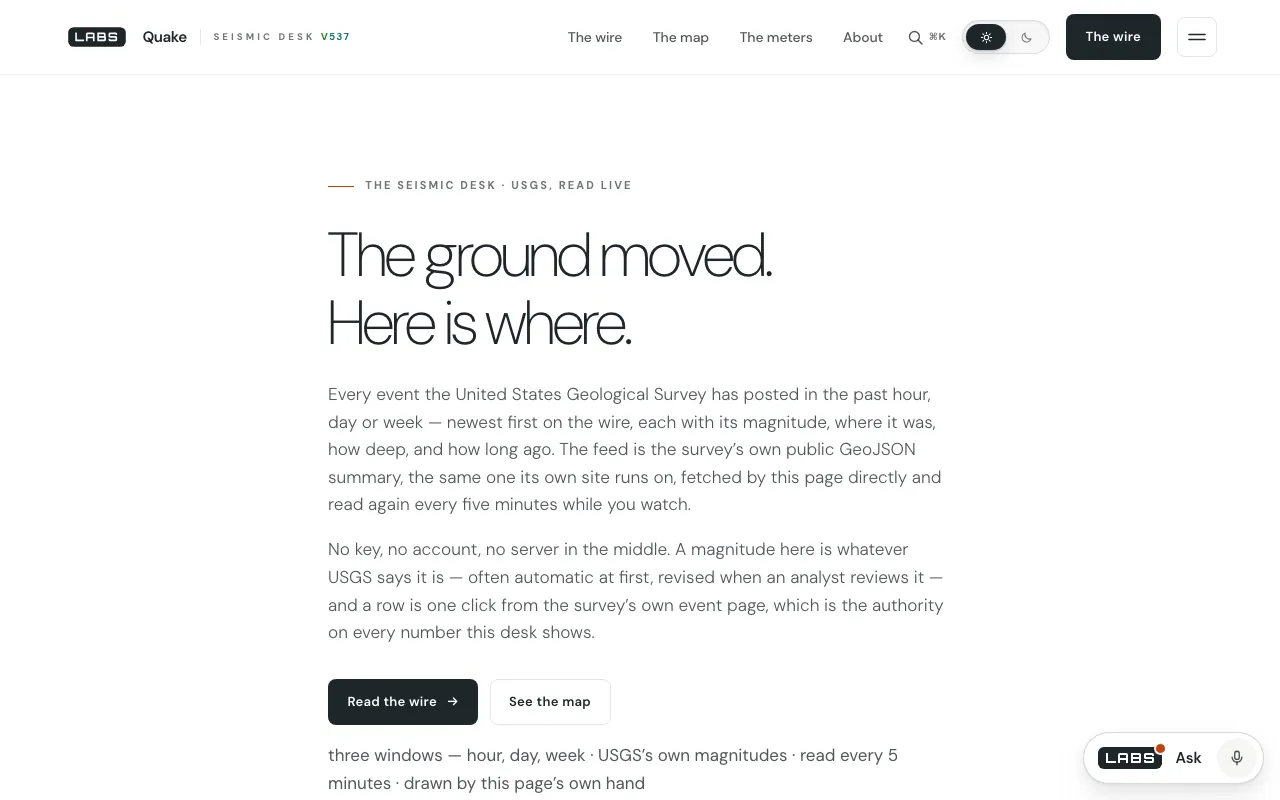
Callouts · desktop capture, 1280 × 800
1Callout 1: The eyebrow names the source outright: “USGS, read live”.
2Callout 2: “Fetched by this page directly and read again every five minutes while you watch.”
3Callout 3: “A magnitude here is whatever USGS says it is” — often automatic at first, revised once an analyst reviews it.
4Callout 4: Three windows: hour, day and week.
5Callout 5: “The meters” — the counts by magnitude band and depth.
Segment 1 · On screen
What it is, and who it is for
Quake is a seismic desk built on the US Geological Survey’s own feed. Choose the past hour, day or week and it shows every event the survey has posted: a newest-first wire, a world map with events ringed by magnitude, counts by magnitude band and by depth, and an optional push alert above a magnitude you set.
It is for people who felt something or saw a headline and want the survey’s list rather than a news summary, for students, and for anyone who wants a quiet notice when a large earthquake happens.
Segment 2 · Behind the picture
How it works
Your browser reads one USGS GeoJSON summary feed per window — keyless and open to any site — and draws the wire, the map and the meters from that single read (app.js lines 1–15). The code’s own comment puts the rule plainly: three renderings of one fetched window, never three fetches, so the list and the counts cannot disagree. It reads again every five minutes. The coastline is Natural Earth’s public-domain 1:110m outline, simplified and carried inside the page, so no map tiles are fetched. Events the feed marks as something other than an earthquake, such as quarry blasts, carry their type on the wire (line 126), and when the wire is cut to the newest 100 it says so while the map and meters still count everything (lines 135–136).
The alerts show the same restraint. alerts.php only stores and removes Web Push subscriptions, after checking the endpoint belongs to one of four push vendors (lines 17–19). A scheduled script reads the hourly feed itself, compares it with what it saw last and sends an empty, signed push; its first run seeds and sends nothing, and no figure ever travels in the notification. Tapping it opens the desk, which reads the wire live.
What it reads
earthquake.usgs.gov summary feeds all_hour, all_day and all_week (GeoJSON), from your browser
Natural Earth 1:110m coastline (public domain), carried inside the page
For alerts: the same hourly feed, read by the scheduled sender on the server
Segment 3 · The test
What we measured, and when
The page came back from the local copy at 20:15:16 UTC at 57,324 bytes. In the same second we read the past-day feed the page reads: 143,309 bytes in 0.04 seconds, 199 events — 8 at magnitude 4.5 or above, 34 between 2.5 and 4.5, and 157 below 2.5. The largest was M5.1, 90 km east-north-east of Tadine, New Caledonia. With 199 events the wire would show the newest 100 and say so, while the meters counted all 199.
The alerts door answered in 90 bytes: no devices, no runs. The sender is a scheduled job that does not run on the local copy, so we did not exercise the live alert path and make no claim about delivery. Our first-screen capture dates from 20:14:08 UTC.
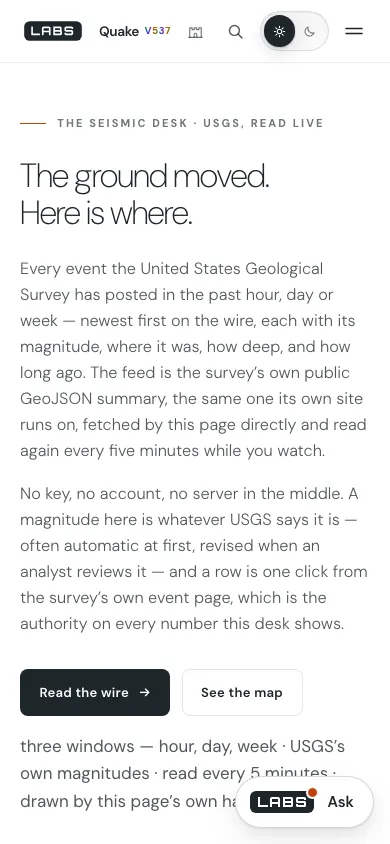
390 × 84420:14:13Z
12
Callouts · phone capture, 390 × 844
1Callout 1: “No key, no account, no server in the middle” stays in the first screen at phone width.
2Callout 2: The Ask launcher sits over part of the figures line in this capture; we did not test it on scroll.
Segment 4 · Other channels
Beside USGS Latest Earthquakes and ENS and EMSC
Each comparator was checked on the date shown. We say what each does better before we say where Quake goes further.
Checked 2026-09-27 20:19 UTC · the map page returned only a browser notice; verified from the survey’s feed page and usgs.gov via search
What it is
The survey’s own near-real-time map of up to 30 days of earthquakes, feeds in five formats, a catalogue API, and ENS, a free email and phone notification service.
What it does better
The primary source, with 30 days on the map, full catalogue search, per-event products, and notifications by email or text for regions you choose.
Where Quake goes further
Quake counts the window by magnitude band and depth on the same screen as the wire, and its push carries no numbers at all — it opens the live desk — with a deliberately silent first run.
A world map and list of latest earthquakes from member institutes, eyewitness felt reports, and the LastQuake apps and messenger bot.
What it does better
Crowdsourced felt reports and testimonies, and strong Euro-Mediterranean coverage from many national institutes.
Where Quake goes further
Every figure on Quake comes from one read of one feed, the page says when its list is cut, and it runs as a single light page with the coastline built in.
Segment 5 · Dropouts
Where it falls short
The map is a fixed 1:110m world outline with no zoom, so a cluster of small events in one region cannot be pulled apart.
Three windows only; the USGS map reaches back 30 days and its catalogue allows any search.
None of the survey’s derived products — Did You Feel It?, ShakeMap, tsunami flags — beyond a link from each row.
One network: outside the US, regional agencies such as EMSC may publish first or with a different magnitude.
Segment 6 · End card
The verdict
Quake promises little and keeps all of it: one feed, one read, three views that agree. For depth, history or felt reports go to the USGS or EMSC; for a glance you can trust, this is enough.