Network: a console that says what a browser cannot measure
A page of network instruments that labels its own limits — captured mid self-test, counted from its code, and set beside Globalping and Bitwarden’s password generator.
Tested 2026-09-27Build 537, local copyDesktop capture 20:14:53ZPhone capture 20:14:58ZPublisher LABS, which also makes this tool
CH 09labs.llc/network/captured 20:14:53Z
12345
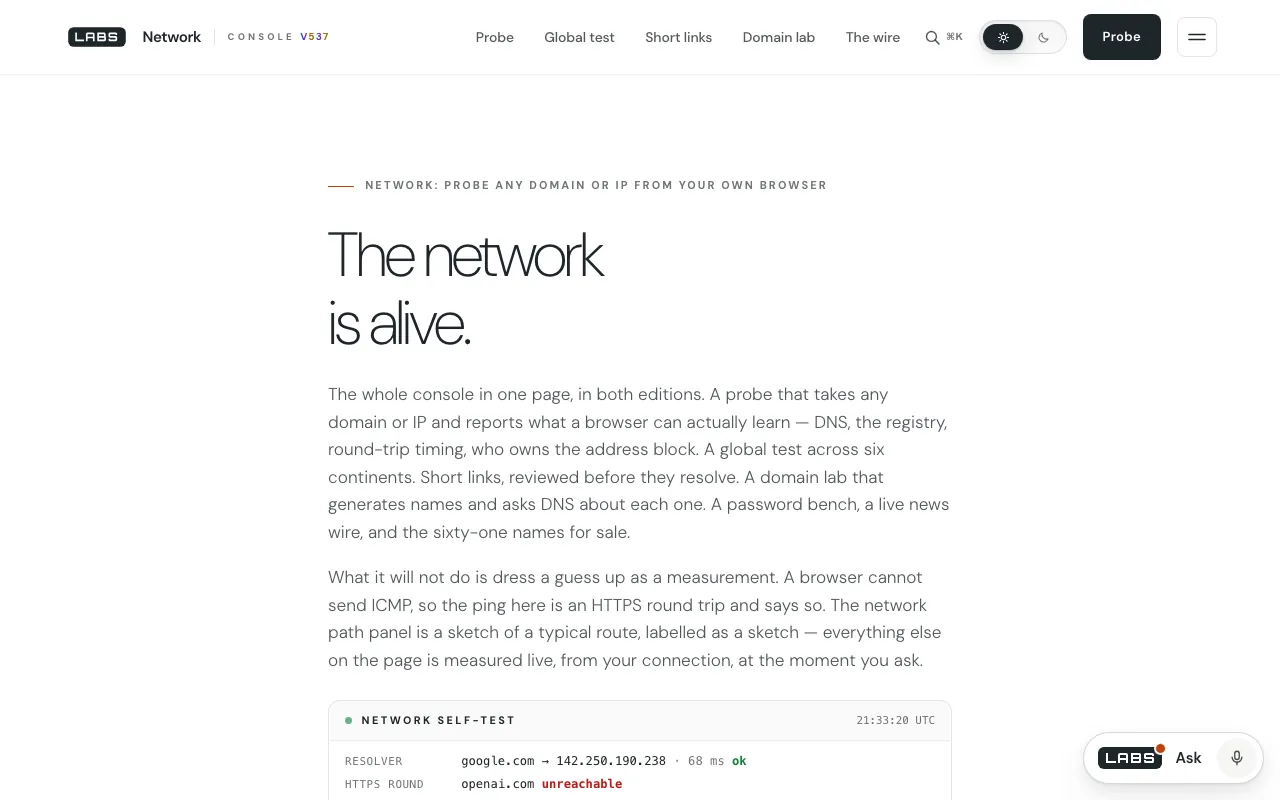
Callouts · desktop capture, 1280 × 800
1Callout 1: The eyebrow: “Network: probe any domain or IP from your own browser”.
2Callout 2: “A browser cannot send ICMP, so the ping here is an HTTPS round trip and says so.”
3Callout 3: The self-test panel, stamped 20:14:53 UTC — the same second our capture file was written.
4Callout 4: A live reading: cloudflare.com resolved to 104.16.133.229 in 67 ms; an HTTPS round trip to netflix.com took 53 ms.
5Callout 5: “Global test” — the sweep across six continents.
Segment 1 · On screen
What it is, and who it is for
Network is a console of browser instruments on one page: a probe for any domain or address (DNS, reachability, your public address, the registration record), an “is it you or the internet?” sweep that times HTTPS round trips to sites on six continents, a short-link maker, a password bench with seven recipes, a domain lab, and a live wire of the Hacker News front page.
It is for anyone troubleshooting a connection or needing a strong password or a short link.
Segment 2 · Behind the picture
How it works
Everything runs in your browser (app.js lines 1–15). The probe asks Google’s DNS-over-HTTPS service, times an HTTPS HEAD request, reads your public address from api.ipify.org and its reverse name from dns.google, and fetches the registration record from rdap.org (lines 198–237). The sweep resolves each site and times a request to it from your own connection — 75 sites grouped by continent, or 50 drawn from a pool of 87 — and rates each continent (lines 488–508). The only server endpoints are the site’s own short-link store, which checks that a code is free before saving and lengthens codes only when the short ones are taken (lines 606–630).
Its signature is candour about the medium. The code’s header calls honesty the whole point: a browser cannot send ICMP, trace a route or read another site’s response, so the console measures what it can and says where it cannot — down to labelling its one drawn network-path panel a sketch. The password bench draws from crypto.getRandomValues with rejection sampling, so each character is chosen uniformly, never from Math.random (lines 29–38), and nothing it makes leaves the page. A probe or a sweep can be exported as a PDF.
What it reads
dns.google (DNS-over-HTTPS), api.ipify.org, rdap.org and hn.algolia.com — all from your browser
The target sites themselves, timed from your connection
labs.llc’s own short-link store: labluxa/check.php and save.php
Segment 3 · The test
What we measured, and when
The page came back from the local copy at 20:17:04 UTC at 126,883 bytes. We asked the short-link store whether the code “zq7x” was free — a read-only check — and it answered {"available":true} in 18 bytes; we saved nothing. Counting the lists in the code: the continental sweep holds 75 sites (25 North America, 10 Europe, 13 Asia, 11 South America, 6 Africa, 10 Oceania) and the random pool 87, of which 50 are drawn per run. The sweep runs only in a browser, so we did not run it.
The capture caught what our command line could not. At 20:14:53 UTC the page’s own self-test ran in the capture browser and printed its results on the first screen — callouts 3 and 4. The phone capture, five seconds later, shows a different reading, openai.com resolving in 49 ms, which is what a live test ought to do.
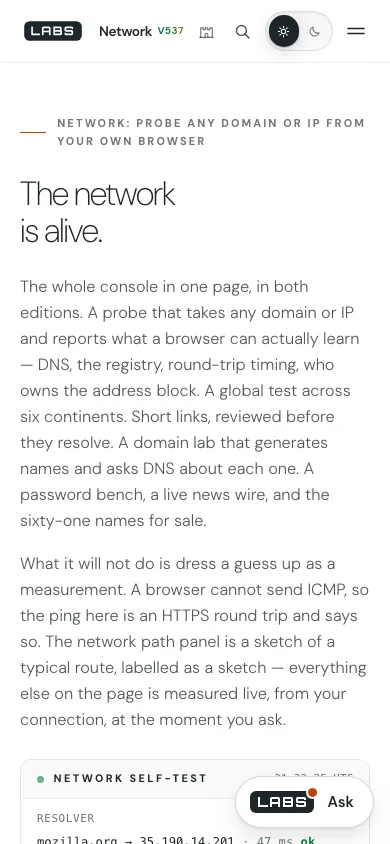
390 × 84420:14:58Z
12
Callouts · phone capture, 390 × 844
1Callout 1: “What it will not do is dress a guess up as a measurement” — kept in the first screen at 390 pixels.
2Callout 2: The Ask launcher covers the self-test’s time stamp in this capture.
Segment 4 · Other channels
Beside Globalping and Bitwarden Password Generator
Each comparator was checked on the date shown. We say what each does better before we say where Network goes further.
A free, open-source platform that runs ping, traceroute, DNS, MTR and HTTP measurements from a worldwide network of community-hosted probes.
What it does better
Real measurements from many locations, including the ICMP ping and traceroute a browser cannot send, and you choose where the test runs.
Where Network goes further
Network answers the everyday question — is it my connection? — by timing sites on six continents from your own browser, rated per continent, with no account; and it keeps the probe, password bench, short links and live wire on one page with a PDF export.
A free generator for random passwords of 5 to 128 characters and for passphrases, made on your device, with a strength tester.
What it does better
A crack-time strength tester beside the generator, and a password manager to save the result into.
Where Network goes further
Network’s bench offers seven recipes — classic, three words, mnemonic, Markov, pronounceable, leet and grown from your own root word — and its code states the rejection sampling behind each character.
Segment 5 · Dropouts
Where it falls short
“Global” means sites hosted around the world, not measurements taken from around the world: every timing is from your own browser.
A no-cors HEAD request succeeds on any HTTP answer, so a site serving an error page still counts as reachable, and the time includes a fresh connection’s DNS and TLS set-up.
A labelling slip: the PDF report calls the continental sweep “~85 sites”; the list holds 75.
Short links need the labs.llc server, and cannot be edited or given analytics.
Segment 6 · End card
The verdict
Network labels its own limits in the interface, which is rarer than it should be. It cannot see the internet from anywhere but your desk — and for the question “is it me?”, your desk is exactly where you want to look from.