Rx.Luxury: a patient’s desk that keeps your data at home
A clinical notebook, a DICOM viewer and two federal directories — the relays measured, the entry screen captured, and the whole set beside Medicare Care Compare and OHIF.
Tested 2026-09-27Build 537, local copyDesktop capture 20:13:45ZPhone capture 20:13:51ZPublisher LABS, which also makes this tool
CH 03labs.llc/rxluxury/captured 20:13:45Z
1234
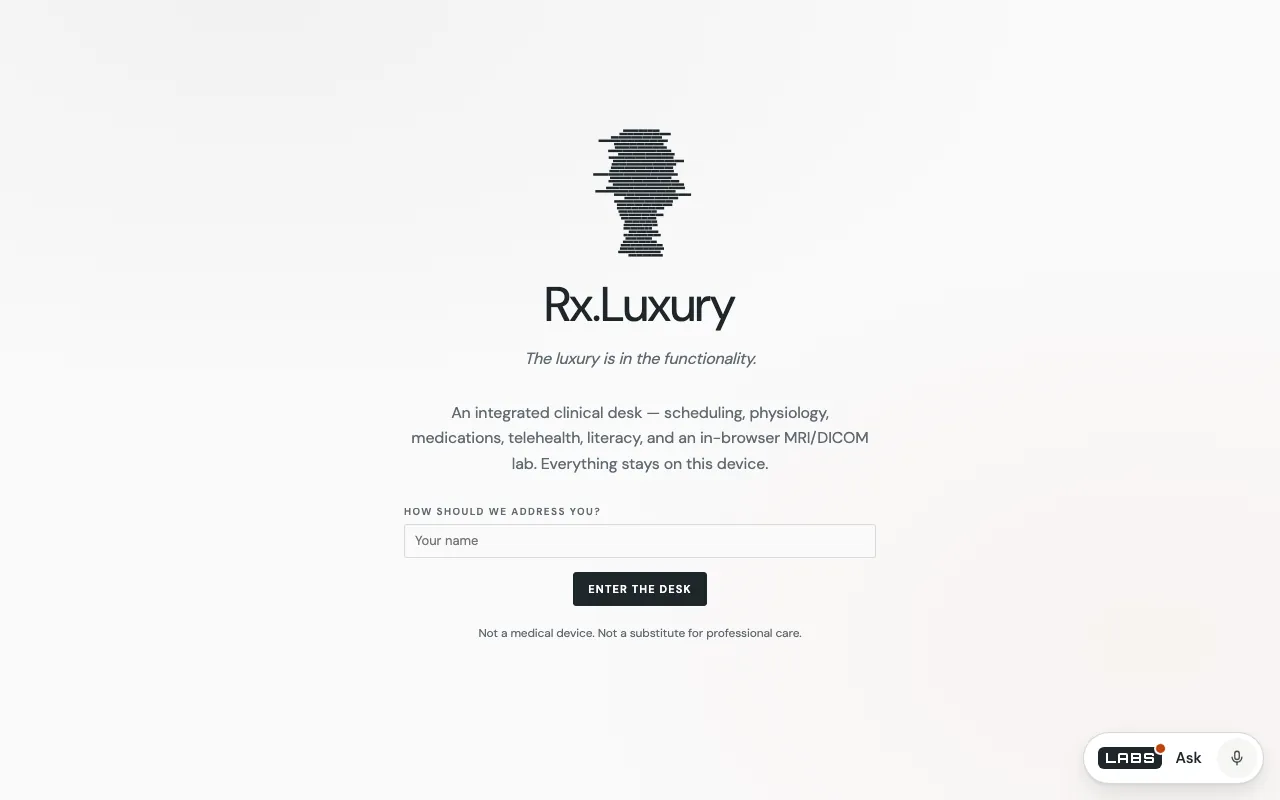
Callouts · desktop capture, 1280 × 800
1Callout 1: The desk lists its parts: scheduling, physiology, medications, telehealth, literacy and an in-browser MRI/DICOM lab.
2Callout 2: “Everything stays on this device” — a promise the code backs, as the next segment shows.
3Callout 3: The gate asks only how to address you. No account, no email address.
4Callout 4: “Not a medical device. Not a substitute for professional care.” — printed under the button, not buried.
Segment 1 · On screen
What it is, and who it is for
Rx.Luxury is a personal clinical desk that runs in the browser: intake notes, symptoms, medications, vitals, a printable visit packet and a viewer for DICOM scan files. Beside it sit two live US directories — clinicians from the federal NPI Registry, and every Medicare-certified hospital with its CMS overall rating where CMS publishes one.
It is for patients and carers in the United States who want their own notes in one place, a tidy packet to take to an appointment, a look at their own scans, and clinicians and hospitals from the official registers rather than an advertiser’s list.
Segment 2 · Behind the picture
How it works
Your side of the desk stays in your browser. State lives in localStorage (app.js lines 64–73); the PDF and ZIP exports are written by hand in save.js, so no outside library is fetched (lines 1–13); scans are parsed locally by a bundled dicom-parser 1.8.21 and drawn with window presets for brain, bone, lung and soft tissue (dicom.js lines 1–25). Mail is opt-in, and only to an address you have confirmed with a six-digit code.
The directories pass through two same-origin relays because neither federal service sends a CORS header, and what those relays leave out is the telling part. An earlier build listed eight invented clinicians with ratings and “next available” times; npi-proxy.php replaced them with the NPPES register and dropped every field it does not hold — no ratings, no insurance networks, no availability (lines 7–31). For hospitals, cms-proxy.php skips the NPI-2 search, which returns billing entities rather than buildings, and reads the CMS facility file, spelling its filters out in full because the short form is silently ignored and returns all 5,419 rows (lines 6–40).
What it reads
NPPES NPI Registry API v2.1, through rxluxury/npi-proxy.php
CMS Hospital General Information (dataset xubh-q36u), through rxluxury/cms-proxy.php
OpenStreetMap Nominatim and Overpass, from your browser, for Germany and Panama
Bundled locally: dicom-parser 1.8.21
Segment 3 · The test
What we measured, and when
Our capture (20:13:45 UTC) shows the entry gate, not the desk behind it, so the callouts describe the first screen only. The relays we measured directly. At 20:14:27 UTC we searched Boston clinicians the way a person might type it — “Cardiology”. The relay answered in 0.083 seconds with six rows, every one a pharmacist with a cardiology specialty. At 20:14:35 we used the register’s own term, “Cardiovascular Disease”: 114 rows in 0.097 seconds, each with an NPI number, credential, address and phone. The page’s own picker supplies the register’s terms; a reader typing plain words would be misled.
Boston hospitals, asked at 20:14:27 UTC, took 1.70 seconds: twelve hospitals, each with CMS id, address, county, phone, type, ownership and an emergency-department flag. Six carried a CMS overall rating — Massachusetts General, Brigham and Women’s and New England Baptist at 5, Boston Medical Center and Beth Israel Deaconess at 3, Tufts at 2 — and six had none.
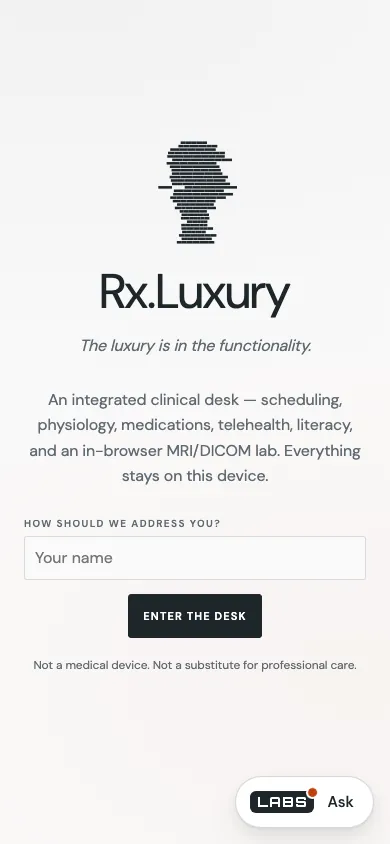
390 × 84420:13:51Z
12
Callouts · phone capture, 390 × 844
1Callout 1: The same gate at 390 pixels: one field and one button.
2Callout 2: The disclaimer keeps its place beneath the button.
Segment 4 · Other channels
Beside Medicare Care Compare and OHIF Viewer
Each comparator was checked on the date shown. We say what each does better before we say where Rx.Luxury goes further.
Checked 2026-09-27 20:19 UTC · the page is built by script and returned no text; verified from medicare.gov pages via search
What it is
Medicare’s official tool for finding and comparing approved providers — clinicians, hospitals, nursing homes, home health, hospice, dialysis and more.
What it does better
Many more provider types and quality measures, and clinician profiles with board certification, education and hospital affiliations.
Where Rx.Luxury goes further
Rx.Luxury keeps your own intake, medications and vitals beside the directory and turns them into a visit packet in the browser, and it opens your own DICOM scans with windowing presets.
An open-source, browser-based medical imaging viewer, a programme of Massachusetts General Hospital, with annotation, segmentation, PET/CT and volume rendering.
What it does better
A far more capable imaging workstation, open source, with a large community behind it.
Where Rx.Luxury goes further
Rx.Luxury’s viewer sits inside a patient-side desk with intake, medications, vitals and the federal directories, and exports PNG, PDF and ZIP without a third-party library.
Segment 5 · Dropouts
Where it falls short
The hospital relay’s title-casing capitalises the letter after an apostrophe: our Boston answer printed “Brigham And Women’S Hospital” and “Boston Children’S Hospital” (cms-proxy.php line 56).
Clinician search depends on the register’s wording: “Cardiology” found six pharmacists and no cardiologists.
No insurance, availability or quality data for clinicians — by design, but Care Compare gives more.
Outside the US there is only an OpenStreetMap radius search for Germany and Panama, which the code itself calls “a real downgrade from NPPES”.
Segment 6 · End card
The verdict
Rx.Luxury’s best feature is a deletion: it threw out invented doctors and now shows only what the federal registers hold, while your notes stay in your browser unless you choose to mail yourself a packet, and your scans never leave the machine. Keep your records here; check credentials and quality on Care Compare.